Category: Assignment #2

  • Part B – Question #4 – Second-Year Course Headline

    “Top 9 Digital Skills You’ll Master In Second-Year That Employers Love”

    Upon writing multiple versions of headlines, I decided to choose this one, regardless if it’s perfect or not. This headline fits perfectly with the audience as it provides a sense of promise to them that the second year digital course will allow them to adapt skills that employers love. As a student in second year taking these digital courses, I can share my positive experience with the first year students and vouch that I truly am gaining skills that will help me in the future. In addition, not only gaining their trust but a promise to their solution. As stated in the previous headlines, you can tell that I enjoy surprising the reader with the “top 9 skills” at the beginning of the headline, capturing the attention of the reader, so they are able to find the solution to their problem, which in this case are first year students seeking experience from second year students about the digital courses.
  • Part B – Question #3 – SCC Advertising Program Headline

    “Top 7 Secrets On How SCC Advertising Program Students Find Jobs Before Graduating”

    Information missing from the instructions resonates with much deeper questions that local graduating high school students think of immediately, which are how much is the tuition per semester, will I get a job at the end of completion, which courses will I be learning, etc. The question is asking to create a generic headline to convince high-school students to join the SCC advertising program, without asking to include answers to questions that are most likely the priority of graduating high-school students.

    The goal of my headline is to capture the attention of the high-school students. Using the promise pleasure strategy, my headline promises the reader something specific, which in this case is the SCC advertising program targeted towards local high school students. The students ultimately want to find the answer to their number one question, does this program guarantee me a promising job in the future? To help answer that question, I use the keyword and number “Top 7” at the beginning of my headline to help capture that immediate attention of the reader and surprise them with the fear-of-missing-out as I promise them valuable, specific, and well-thought information that stands out from generic articles that utilize even numbers and without including a promise, often leading to dissatisfaction and low click-through rates.

  • Part B – Question #2 – Headline Intent vs Outcome

    “If You Don’t Know What To Get Your Mom For Christmas. Here Are The Top 17 Gifts To Buy”.

    The primary intent of this headline is to create urgency to purchase a gift through the article.

    I believe the response in the second half of the headline “Here Are The Top 17 Gifts To Buy”, designed that turning point to the reader to take action. This is because I include a “top” list of gifts to purchase. What helps as the act of response is the odd number 17, that creates that sense of reassurance to the reader that the products in the list are actually good and not generic like most articles who use even numbers in their headline.

    The intent is appropriate for my target audience because they are people seeking to solve a specific problem. During the holidays, products become more expensive and less stockage, leaving you with not much time to work with. It doesn’t help that the person you are buying a gift for, says they want nothing, making time an even bigger problem. People become desperate for gift choices that will come in time, priced reasonably, unique and most importantly, makes your mother happy on Christmas.

  • Part B – Question #1 – Headline Variation

    1. “17 Last-Minute Christmas Gifts For Mom’s Who Say They Want “Nothing”.
    2. “Mom Didn’t Want Anything For Christmas. So We Chose The Best Gifts For Her”.
    3. “If You Don’t Know What To Get Your Mom For Christmas. Here Are The Top 17 Gifts To Buy”.
    1. I chose to use this headline because many people during the Christmas holidays can relate to not knowing what to gift their mother. By turning the headline into a relatable and humorous situation, it captures the readers attention in hopes of the article helping them to find the perfect gift in time.
    2. I chose to use this headline because it captures the attention of the reader instantly. The readers are curious to know the outcome of the gifts that they chose for their mom and if it was the correct choice, allowing them to save some of the gift ideas to use in the future.
    3. I chose to use this headline because of the keyword selection “top”, providing the reader a sense of reassurance that this article will list them the top quality gifts instead of purchasing blindly without further details on the product.
    1. The reasoning behind my first headline is that it utilizes a number, specifically an odd number to lure in the brain candy for my readers. The article is showcasing a list, giving the reader a clear idea of what to expect prior to reading. Numbers express certainty, increasing open-click rates for people who are seeking answers and solutions. By adding an odd number, you are being specific. If I was to remove the number from the headline and begin it with “Last-Minute”, that would be too general, even though both offer the same outcome. 
    2. The reasoning behind my second headline is that it calls for attention. The content being displayed in the headline is actually useful, capturing the average person’s attention span of 8-12 seconds. In class, we spoke about the 4 U’s and how they are written for attention-driven headlines. I searched on Google for the exact headline and was shown “no results found”, meaning it was not used by anyone else but myself. The headline is unique because it’s not an everyday situation that occurs in most people’s lives, only near the holidays. In addition, it provides a sense of urgency, tailored toward those who are seeking to search for specific answers related to my headline.
    3. The reasoning behind my third headline is that it uses the acronym “SHINE”, as a part of the headline formula. The specificity comes from the uniqueness of the problem, which is not knowing what to get for your mother on Christmas after she said she didn’t want anything. Helpfulness is included in the second half of the headline when the author provides the reader a list of 17 gifts to purchase, in addition to the sense of immediacy as the headline targets towards those who voluntarily search for a quick-solution to their problem. Newsworthiness meaning that the information is useful. By avoiding clickbait behaviour, this strongly indicates the headline provides useful information rather than useless. Lastly, entertainment value in a headline provokes amusement and curiosity from the reader. In the headline, I clearly utilize a small portion of humor as many can relate to the same problem of their mother not wanting anything for Christmas, which drives the reader to become curious about the types of gifts in the list. Lars Lofgren advises that a good headline begins with the word “if”. This small change strongly impacts the results of your headline to be either positive or negative. The keyword “if” uses the identify and qualify strategy, speaking and targeting the speaker directly, like they can relate to this and it’s specifically for them.
  • Part A – Question #3 – Click Motivation

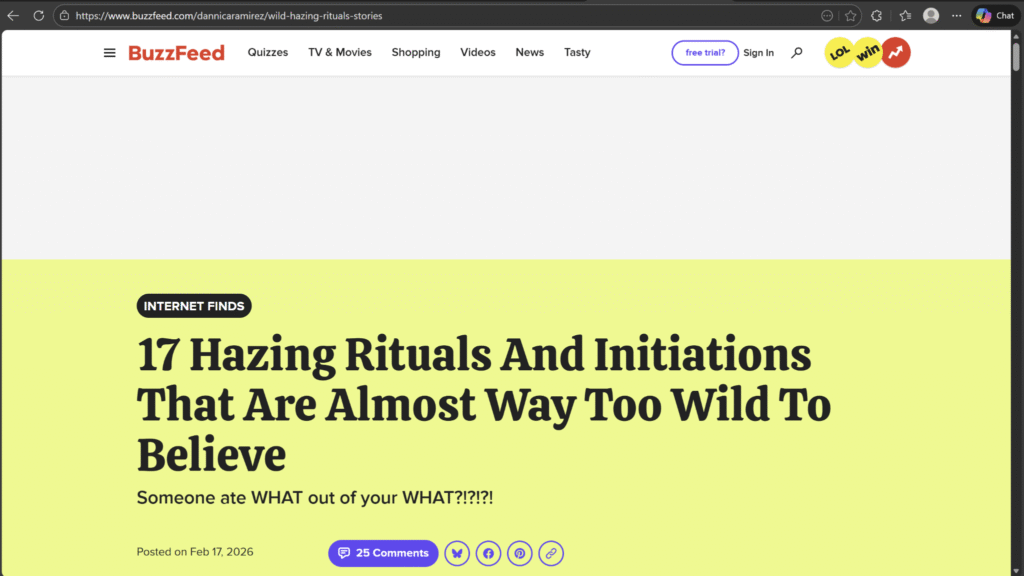
    “17 Hazing Rituals And Initiations That Are Almost Way Too Wild To Believe”

    Source: 17 Wildest Hazing Rituals People Have Been A Part Of

    I clicked on this headline because I was curious to know which “hazing rituals and initiations” were shocking to believe. Nowadays, I view these types of facts/news across multiple social media platforms, hence why I’m curious to know if these rituals and initiations have come across my feed before. Another reason why I clicked it was not because of the headline, but the subhead. The subhead is quite weird, “Someone ate WHAT out of your WHAT?!” which caught my attention and added to my current curiosity to find out what the author wrote regarding that statement in the article.

    I clicked on this headline because of the multiple uses of two-word and three-word phrases. The two-word phrase ”Hazing Rituals” immediately caught my attention as these are words that were easily scannable in a fraction of a second when I was skimming the headline, and it provided maximum impact, meaning they filled an information gap and made me understand that this article will be discussing about unusual rituals without having the need to reveal details. Adding to keyword phrases, In class we discussed superlatives and how they influence click-behavior. I noticed the use of a superlative in the second-half of the headline, “Are Almost Way Too Wild To Believe”. The word “Wild is not directly a superlative but instead a periphrastic superlative. This is because the author uses various words surrounding to build the highest of its kind. “Way Too” and “To Believe” are intensifier keywords that are added instead of using a singular word such as “Wild”, to increase the intensity of the content’s excellence and making readers think that they have reached that point of being unbelievable, promoting click-behavior.

  • Part A – Question #2 – Accuracy & Representation

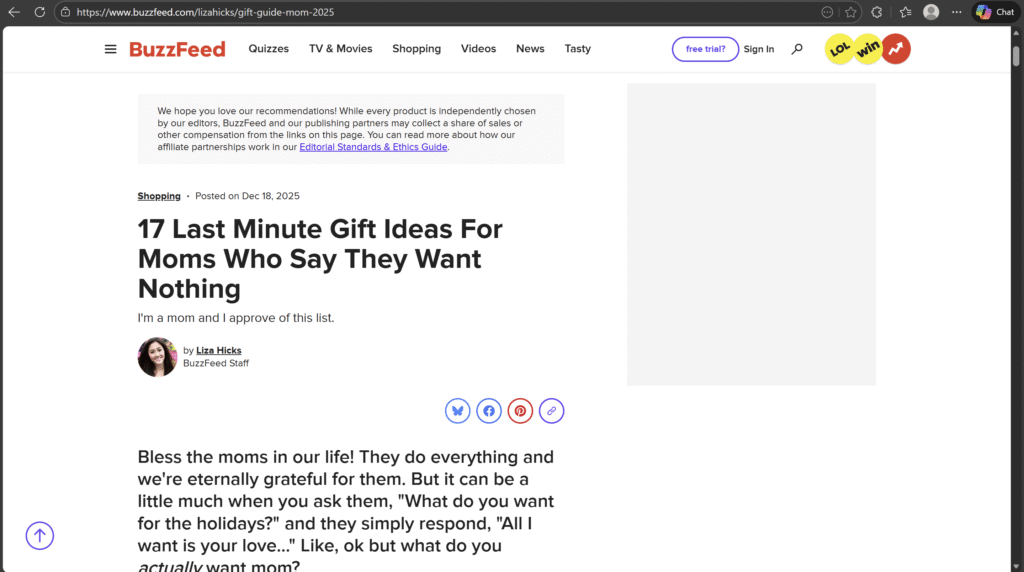
    I believe that the headline was an accurate representation of the article. The article begins with describing the relation of our mothers who either are too picky, indecisive or simply ask for nothing for Christmas but you think to yourself, “Like, ok but what do you actually want mom.” The article then jumps right into the list of 17 gift ideas. Each gift idea includes what it is, how mom’s will enjoy it, a brief description of the item (where it’s made, style options, etc.), and the price of the item. The article ends at the last gift idea, which I appreciate because the headline clearly resonates with the article and was straight to the delivery.

    In class, we discussed key elements on what makes a misleading vs effective headline. One key element in the headline that I noticed was effective was the use of humor but at an appropriate amount. In this case, is the relatable situation of not knowing what to get for your mom for Christmas after she said she wanted nothing. When I mean appropriate, the headline uses just the right amount of humor that gives the reader a laugh while not misleading them of its context. The author does a good job by connecting the article’s knowledgeable information, directly with the headline, no twists or clickbait. It’s important that a headline doesn’t consist of too much humor because it essentially provides your readers a disservice. Including the use of an active voice instead of a passive voice, is another key element that ties with this headline. The author transformed the headline, to become easier to understand, making the viewer interested in clicking on the article to read. They avoided using a passive voice, for example, “17 Gift Ideas For Mothers On Christmas”, which sounds plain and generic, turning down potential readers.

  • Part A – Question #1 – Headline Resonance

    “17 Last Minute Christmas Gift Ideas For Moms Who Say They Want Nothing”

    Source:  17 Last Minute Christmas Gifts For Mom

    This headline resonates with me because of how relatable this situation is with many people who are shopping for Christmas gifts for their mother. I struggle sometimes on what I should get for my mother nearly every year because it’s difficult to get something unique and different that she already doesn’t have. Upon reading this headline, it gives me hope on new gift ideas that I should keep in mind for future gifts.

    This headline makes it promise something to the audience. The headline is both specific and relatable on what the writer intends to deliver as many people shop last minute Christmas gifts for their mother as they genuinely don’t know what to get her, and it doesn’t help that they say “I want nothing”, it just adds pressure and forces the buyer to buy something so guilt doesn’t hit them. I also noticed in the headline that they used an odd number instead of an even number. The physiological trick is that readers, including myself, will more likely read an article if the headline consists of an odd number, meaning the writer put in the time to provide good and thoughtful reasonings rather than most articles published online who use an even number and 9 out of 10 times the information turns out to be generic and not so useful information, essentially wasting the readers time.