“17 Hazing Rituals And Initiations That Are Almost Way Too Wild To Believe”
Source: 17 Wildest Hazing Rituals People Have Been A Part Of
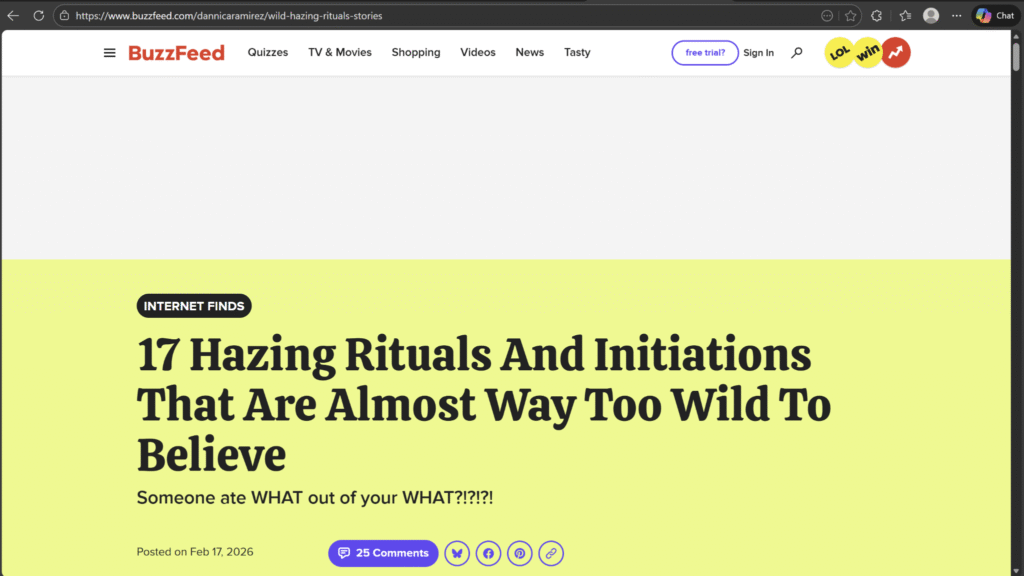
I clicked on this headline because I was curious to know which “hazing rituals and initiations” were shocking to believe. Nowadays, I view these types of facts/news across multiple social media platforms, hence why I’m curious to know if these rituals and initiations have come across my feed before. Another reason why I clicked it was not because of the headline, but the subhead. The subhead is quite weird, “Someone ate WHAT out of your WHAT?!” which caught my attention and added to my current curiosity to find out what the author wrote regarding that statement in the article.
I clicked on this headline because of the multiple uses of two-word and three-word phrases. The two-word phrase ”Hazing Rituals” immediately caught my attention as these are words that were easily scannable in a fraction of a second when I was skimming the headline, and it provided maximum impact, meaning they filled an information gap and made me understand that this article will be discussing about unusual rituals without having the need to reveal details. Adding to keyword phrases, In class we discussed superlatives and how they influence click-behavior. I noticed the use of a superlative in the second-half of the headline, “Are Almost Way Too Wild To Believe”. The word “Wild” is not directly a superlative but instead a periphrastic superlative. This is because the author uses various words surrounding to build the highest of its kind. “Way Too” and “To Believe” are intensifier keywords that are added instead of using a singular word such as “Wild”, to increase the intensity of the content’s excellence and making readers think that they have reached that point of being unbelievable, promoting click-behavior.
Leave a Reply