Category: Assignment #3

  • Question #4 – Original & Revised Introduction Article Differences

    What I learned from this assignment is how to properly implement the F-pattern layout for better scanability for my readers. In my original introduction article, I added too many unnecessary complex-language, not knowing that my readers will scan and not read every word. By focusing on replacing complicated-sentences with direct verbs such as “provide the opportunitywith “finding the perfect local golfer has never been easier”. 

    In addition to reducing complex-language, I applied this strategy with the services bullet-points section in the article. I removed certain “golf terms” such as “establish your handicap”  to “track your scores each round”. Knowing that some of my readers will not know what a “handicap” is due to their golf skill-level, I substituted those certain keywords from the definition to be understandable from the view of both non-golfers and experienced-golfers.

    Including the use of important keywords such as “Windsor”, and “Golfing Partner”, I placed these keywords on the top-left of the page as studies have shown that 80% of visitors scan that area on a page, skimming over everything else around it. I added larger headers to capture the attention of the readers, making it seem like a navigation point when they stop to read what it is and if it correlates to their needs. Upon experimenting myself, I found it much quicker using this strategy as I know the reader, including myself, will not read every word, but rather scan the page using the F-pattern layout.

    At the end of the article, I added a call-to-action “Visit our website and sign-up today to find your perfect golfing partner: www.gimmielinks.com”. This CTA navigates the visitor to their needs, which is to find a local golf partner. I learned that by adding a small message next to the CTA, it helps to remind the audience of their needs to be fulfilled, rather than just the link to my website. 
  • Question #3 – Part B) – F-Pattern & Plain English Writing Principles

    The most challenging aspect of applying the F-Pattern and Plain English writing principles was making sure that the audience knew what GimmieLinks was about in a professional tone while avoiding complex language and longer/harder keywords in sentence structures. Before learning about F-patterns and the statistics behind how audiences view your content, I would constantly write long over-complicated paragraphs, using advanced keywords to seem “professional”. Looking back, I realized that the majority of visitors will not stop and read each word but rather scan certain areas in the F-pattern horizontal/vertical layouts. 

    What I did to overcome these old habits was I valued certain informative keywords such as “Windsor”, “Golfing Partner”, “PGA”, and more to the left side of my page, under headers for easier navigation since scanability is key for my visitors. As stated in previous questions, Instead of writing long-text paragraphs for each of my services, I cramped it down into a bulleted list with minimal simple text for better comprehension, capturing the attention as the bulleted points follow the F-pattern layout.

  • Question #3 – Part A) – Improve Readability

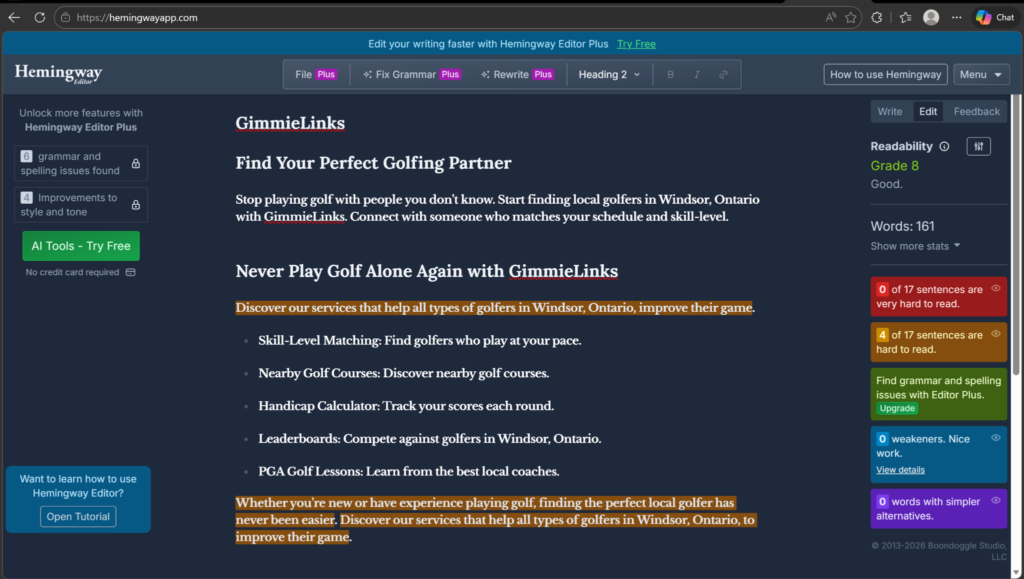
    One specific technique that I used to improve readability in my revised version was I used bullet-points to describe the services that GimmieLinks has to offer for better scanability, rather than using long-complex sentences. The reasoning behind the strategy is that the F-pattern supports vertical scan down the left side, where the majority of readers scan that area in hopes of finding relevant and important information at a much faster pace. To test this strategy to see if it improves readability, I used a popular tool called Hemingway Editor, to rate my readability score. The score I achieved was Grade 8 readability, which is what I was aiming for, making this strategy a success!

  • Question #3 – Three Main Objectives

    Objective #1: Find what they need


    The new post addresses the first objective of plain English writing by revising the F-pattern to use keywords such as “Windsor”, and “Golfing Partner”, specifically aiming the location to be placed on the top-left of the page as 80% of visitors, scan that area when reading content on pages. I ensured that I used larger headers to capture the attention of the visitor so they can use them as a guide to find what they need much quicker as I know the visitor will not read every word I publish, but rather scan specific areas of the page.

    Objective #2: Understand it

    The new post addresses the second objective of plain english writing by removing complex language and ensuring that the content is eighth-grade level comprehension. An original complex sentence that I removed was “provide the opportunity for golfers residing in Windsor, Ontario” as it used unnecessary words and held space that could’ve been easily shortened with simple verbs or even removed all at once because I’ve mentioned what GimmieLinks is to my audience in different areas of my introduction article, meaning they have an idea of what it is and I would like to keep my article as simple and straight forward as possible to not waste time for both myself and the visitors. In addition to ensuring that the audience understands what GimmieLinks provides, I decided to keep the bulleted list of services offered, to help give a better understanding to the audience. I made some small tweaks in the revised version, which were removing complex language in the “handicap calculator” from “establish your handicap” to “track your scores each round”. I know many of my readers will not know what a “handicap” is, so I switched certain keywords in the definition to become easier to read and understand.

    Objective #3: Use it to fulfill their purpose

    The new post addresses the third objective of plain english writing by leaving a call-to-action at the end of the article “Visit our website and sign-up today to find your perfect golfing partner: www.gimmielinks.com”. This call-to-action fulfills the purpose of the visitor’s need by providing a direct link to GimmieLink’s website so they can sign-up and begin searching for their desired golf partner. The old version utilized a call-to-action but did not include any directions but rather than just a link to the website.

  • Question #2 – Revised Introduction Article

    GimmieLinks

    Find Your Perfect Golfing Partner

    Stop playing golf with people you don’t know. Start finding local golfers in Windsor, Ontario with GimmieLinks. Connect with someone who matches your schedule and skill-level.

    Never Play Golf Alone Again with GimmieLinks

    • Skill-Level Matching: Find golfers who play at your pace.
    • Nearby Golf Courses: Discover nearby golf courses.
    • Handicap Calculator: Track your scores each round.
    • Leaderboards: Compete against golfers in Windsor, Ontario.
    • PGA Golf Lessons: Learn from the best local coaches.

    Whether you’re new or have experience playing golf, finding the perfect local golfer has never been easier. Discover our services that help all types of golfers in Windsor, Ontario, to improve their game.

    Windsor, Ontario’s Golf Courses

    Figure 1: Ambassador Golf Club, a local golf course where our members connect.Visit our website and sign-up today to find your perfect golfing partner: www.gimmielinks.com

  • Question #1 – Part C) –  Plain Language Writing For The Web

    Plain language writing for the web is prioritizing clear communication with the reader’s needs rather than through complex language. The importance of writing in plain language writing, comes down to you realizing and assuming that the visitors will not read your entire content, meaning your copy should jump right into the point and answer the needs from the reader as it’s the number one reason why they clicked on your content in the beginning – to receive answers to their needs. We tend to use complex language in the copy to make it seem like we are explaining in detail to impress the reader even though in reality, you’re only making things worse by making the text harder to read and understand. They say to write for an audience of skimmers so that your copy becomes much more effective. This does not mean that you should not include technical terms or write to the lowest common denominator but to utilize them appropriately because it values the reader’s time. By using keywords that match search intent and language, can greatly improve clicks. Using my business as an example, I can create an engaging headline such as, “5 Easy Ways To Find Your Golfing Partner”. The headline is simple to read with no complex language and provides the specific need to the reader, which are ways to find a golfing partner. 

  • Question #1 – Part B) – Plain English Writing Difference

    What makes plain English writing different from plain language writing is it’s simpler to understand and it visually looks easier to read. Readers, including me, dislike having to search up definitions to unnecessary complicated sentences, just so it looks more professional in the article. The rule of thumb is if the writing is not eighth grade level comprehension, it will fail to perform well if published online. This is because people prefer to read a copy that has short, plain, and easy to read sentences. In addition, copywriting should use an active voice rather than passive voice as it is an active voice that uses fewer words, promotes engagement, and speaks directly to the reader and what they need to do. Rather than a passive voice will act as the reader is receiving the action, sort of like viewing instructions on how to ride a bike but not actually trying it out and engaging in the activity. An example of plain English writing that we discussed in class was used by Winnie The Pooh. He talks about plain english writing using the sentence “what about lunch?” rather than “what are we going to eat for lunch in the afternoon later today”. Winnie gets straight to the point while answering the needs to the viewer but in a much simpler form.

  • Question #1 – Part A)- Plain English Writing

    Plain english writing is a type of style used in copywriting to simplify the text to become easier to read while ensuring that it avoids the use of unnecessary complex language. What I mean by complex language are long sentences using “advanced vocabulary” words that eighth graders wouldn’t understand and not engaging with the reader by substituting the complex language with a CTA button or anchor text. The truth is the majority of people are too busy to spend 15 seconds or less to ask themselves if they should engage with your page, before even reading it. Plain english writing examples can include writing in shorter and clearer sentences, organizing information logically, and focusing on what the reader needs to know. By applying these strategies into your copywriting, studies have shown that approximately 40% of readers will understand the text better and 34% will agree that the copy is well-written.