Author: gimmielinks@gmail.com

  • Question #3 – Three Main Objectives

    Objective #1: Find what they need


    The new post addresses the first objective of plain English writing by revising the F-pattern to use keywords such as “Windsor”, and “Golfing Partner”, specifically aiming the location to be placed on the top-left of the page as 80% of visitors, scan that area when reading content on pages. I ensured that I used larger headers to capture the attention of the visitor so they can use them as a guide to find what they need much quicker as I know the visitor will not read every word I publish, but rather scan specific areas of the page.

    Objective #2: Understand it

    The new post addresses the second objective of plain english writing by removing complex language and ensuring that the content is eighth-grade level comprehension. An original complex sentence that I removed was “provide the opportunity for golfers residing in Windsor, Ontario” as it used unnecessary words and held space that could’ve been easily shortened with simple verbs or even removed all at once because I’ve mentioned what GimmieLinks is to my audience in different areas of my introduction article, meaning they have an idea of what it is and I would like to keep my article as simple and straight forward as possible to not waste time for both myself and the visitors. In addition to ensuring that the audience understands what GimmieLinks provides, I decided to keep the bulleted list of services offered, to help give a better understanding to the audience. I made some small tweaks in the revised version, which were removing complex language in the “handicap calculator” from “establish your handicap” to “track your scores each round”. I know many of my readers will not know what a “handicap” is, so I switched certain keywords in the definition to become easier to read and understand.

    Objective #3: Use it to fulfill their purpose

    The new post addresses the third objective of plain english writing by leaving a call-to-action at the end of the article “Visit our website and sign-up today to find your perfect golfing partner: www.gimmielinks.com”. This call-to-action fulfills the purpose of the visitor’s need by providing a direct link to GimmieLink’s website so they can sign-up and begin searching for their desired golf partner. The old version utilized a call-to-action but did not include any directions but rather than just a link to the website.

  • Question #2 – Revised Introduction Article

    GimmieLinks

    Find Your Perfect Golfing Partner

    Stop playing golf with people you don’t know. Start finding local golfers in Windsor, Ontario with GimmieLinks. Connect with someone who matches your schedule and skill-level.

    Never Play Golf Alone Again with GimmieLinks

    • Skill-Level Matching: Find golfers who play at your pace.
    • Nearby Golf Courses: Discover nearby golf courses.
    • Handicap Calculator: Track your scores each round.
    • Leaderboards: Compete against golfers in Windsor, Ontario.
    • PGA Golf Lessons: Learn from the best local coaches.

    Whether you’re new or have experience playing golf, finding the perfect local golfer has never been easier. Discover our services that help all types of golfers in Windsor, Ontario, to improve their game.

    Windsor, Ontario’s Golf Courses

    Figure 1: Ambassador Golf Club, a local golf course where our members connect.Visit our website and sign-up today to find your perfect golfing partner: www.gimmielinks.com

  • Question #1 – Part C) –  Plain Language Writing For The Web

    Plain language writing for the web is prioritizing clear communication with the reader’s needs rather than through complex language. The importance of writing in plain language writing, comes down to you realizing and assuming that the visitors will not read your entire content, meaning your copy should jump right into the point and answer the needs from the reader as it’s the number one reason why they clicked on your content in the beginning – to receive answers to their needs. We tend to use complex language in the copy to make it seem like we are explaining in detail to impress the reader even though in reality, you’re only making things worse by making the text harder to read and understand. They say to write for an audience of skimmers so that your copy becomes much more effective. This does not mean that you should not include technical terms or write to the lowest common denominator but to utilize them appropriately because it values the reader’s time. By using keywords that match search intent and language, can greatly improve clicks. Using my business as an example, I can create an engaging headline such as, “5 Easy Ways To Find Your Golfing Partner”. The headline is simple to read with no complex language and provides the specific need to the reader, which are ways to find a golfing partner. 

  • Question #1 – Part B) – Plain English Writing Difference

    What makes plain English writing different from plain language writing is it’s simpler to understand and it visually looks easier to read. Readers, including me, dislike having to search up definitions to unnecessary complicated sentences, just so it looks more professional in the article. The rule of thumb is if the writing is not eighth grade level comprehension, it will fail to perform well if published online. This is because people prefer to read a copy that has short, plain, and easy to read sentences. In addition, copywriting should use an active voice rather than passive voice as it is an active voice that uses fewer words, promotes engagement, and speaks directly to the reader and what they need to do. Rather than a passive voice will act as the reader is receiving the action, sort of like viewing instructions on how to ride a bike but not actually trying it out and engaging in the activity. An example of plain English writing that we discussed in class was used by Winnie The Pooh. He talks about plain english writing using the sentence “what about lunch?” rather than “what are we going to eat for lunch in the afternoon later today”. Winnie gets straight to the point while answering the needs to the viewer but in a much simpler form.

  • Question #1 – Part A)- Plain English Writing

    Plain english writing is a type of style used in copywriting to simplify the text to become easier to read while ensuring that it avoids the use of unnecessary complex language. What I mean by complex language are long sentences using “advanced vocabulary” words that eighth graders wouldn’t understand and not engaging with the reader by substituting the complex language with a CTA button or anchor text. The truth is the majority of people are too busy to spend 15 seconds or less to ask themselves if they should engage with your page, before even reading it. Plain english writing examples can include writing in shorter and clearer sentences, organizing information logically, and focusing on what the reader needs to know. By applying these strategies into your copywriting, studies have shown that approximately 40% of readers will understand the text better and 34% will agree that the copy is well-written.

  • Part B – Question #4 – Second-Year Course Headline

    “Top 9 Digital Skills You’ll Master In Second-Year That Employers Love”

    Upon writing multiple versions of headlines, I decided to choose this one, regardless if it’s perfect or not. This headline fits perfectly with the audience as it provides a sense of promise to them that the second year digital course will allow them to adapt skills that employers love. As a student in second year taking these digital courses, I can share my positive experience with the first year students and vouch that I truly am gaining skills that will help me in the future. In addition, not only gaining their trust but a promise to their solution. As stated in the previous headlines, you can tell that I enjoy surprising the reader with the “top 9 skills” at the beginning of the headline, capturing the attention of the reader, so they are able to find the solution to their problem, which in this case are first year students seeking experience from second year students about the digital courses.

  • Part B – Question #3 – SCC Advertising Program Headline

    “Top 7 Secrets On How SCC Advertising Program Students Find Jobs Before Graduating”

    Information missing from the instructions resonates with much deeper questions that local graduating high school students think of immediately, which are how much is the tuition per semester, will I get a job at the end of completion, which courses will I be learning, etc. The question is asking to create a generic headline to convince high-school students to join the SCC advertising program, without asking to include answers to questions that are most likely the priority of graduating high-school students.

    The goal of my headline is to capture the attention of the high-school students. Using the promise pleasure strategy, my headline promises the reader something specific, which in this case is the SCC advertising program targeted towards local high school students. The students ultimately want to find the answer to their number one question, does this program guarantee me a promising job in the future? To help answer that question, I use the keyword and number “Top 7” at the beginning of my headline to help capture that immediate attention of the reader and surprise them with the fear-of-missing-out as I promise them valuable, specific, and well-thought information that stands out from generic articles that utilize even numbers and without including a promise, often leading to dissatisfaction and low click-through rates.

  • Part B – Question #2 – Headline Intent vs Outcome

    “If You Don’t Know What To Get Your Mom For Christmas. Here Are The Top 17 Gifts To Buy”.

    The primary intent of this headline is to create urgency to purchase a gift through the article.

    I believe the response in the second half of the headline “Here Are The Top 17 Gifts To Buy”, designed that turning point to the reader to take action. This is because I include a “top” list of gifts to purchase. What helps as the act of response is the odd number 17, that creates that sense of reassurance to the reader that the products in the list are actually good and not generic like most articles who use even numbers in their headline.

    The intent is appropriate for my target audience because they are people seeking to solve a specific problem. During the holidays, products become more expensive and less stockage, leaving you with not much time to work with. It doesn’t help that the person you are buying a gift for, says they want nothing, making time an even bigger problem. People become desperate for gift choices that will come in time, priced reasonably, unique and most importantly, makes your mother happy on Christmas.

  • Part B – Question #1 – Headline Variation

    1. “17 Last-Minute Christmas Gifts For Mom’s Who Say They Want “Nothing”.
    2. “Mom Didn’t Want Anything For Christmas. So We Chose The Best Gifts For Her”.
    3. “If You Don’t Know What To Get Your Mom For Christmas. Here Are The Top 17 Gifts To Buy”.
    1. I chose to use this headline because many people during the Christmas holidays can relate to not knowing what to gift their mother. By turning the headline into a relatable and humorous situation, it captures the readers attention in hopes of the article helping them to find the perfect gift in time.
    2. I chose to use this headline because it captures the attention of the reader instantly. The readers are curious to know the outcome of the gifts that they chose for their mom and if it was the correct choice, allowing them to save some of the gift ideas to use in the future.
    3. I chose to use this headline because of the keyword selection “top”, providing the reader a sense of reassurance that this article will list them the top quality gifts instead of purchasing blindly without further details on the product.
    1. The reasoning behind my first headline is that it utilizes a number, specifically an odd number to lure in the brain candy for my readers. The article is showcasing a list, giving the reader a clear idea of what to expect prior to reading. Numbers express certainty, increasing open-click rates for people who are seeking answers and solutions. By adding an odd number, you are being specific. If I was to remove the number from the headline and begin it with “Last-Minute”, that would be too general, even though both offer the same outcome. 
    2. The reasoning behind my second headline is that it calls for attention. The content being displayed in the headline is actually useful, capturing the average person’s attention span of 8-12 seconds. In class, we spoke about the 4 U’s and how they are written for attention-driven headlines. I searched on Google for the exact headline and was shown “no results found”, meaning it was not used by anyone else but myself. The headline is unique because it’s not an everyday situation that occurs in most people’s lives, only near the holidays. In addition, it provides a sense of urgency, tailored toward those who are seeking to search for specific answers related to my headline.
    3. The reasoning behind my third headline is that it uses the acronym “SHINE”, as a part of the headline formula. The specificity comes from the uniqueness of the problem, which is not knowing what to get for your mother on Christmas after she said she didn’t want anything. Helpfulness is included in the second half of the headline when the author provides the reader a list of 17 gifts to purchase, in addition to the sense of immediacy as the headline targets towards those who voluntarily search for a quick-solution to their problem. Newsworthiness meaning that the information is useful. By avoiding clickbait behaviour, this strongly indicates the headline provides useful information rather than useless. Lastly, entertainment value in a headline provokes amusement and curiosity from the reader. In the headline, I clearly utilize a small portion of humor as many can relate to the same problem of their mother not wanting anything for Christmas, which drives the reader to become curious about the types of gifts in the list. Lars Lofgren advises that a good headline begins with the word “if”. This small change strongly impacts the results of your headline to be either positive or negative. The keyword “if” uses the identify and qualify strategy, speaking and targeting the speaker directly, like they can relate to this and it’s specifically for them.
  • Part A – Question #3 – Click Motivation

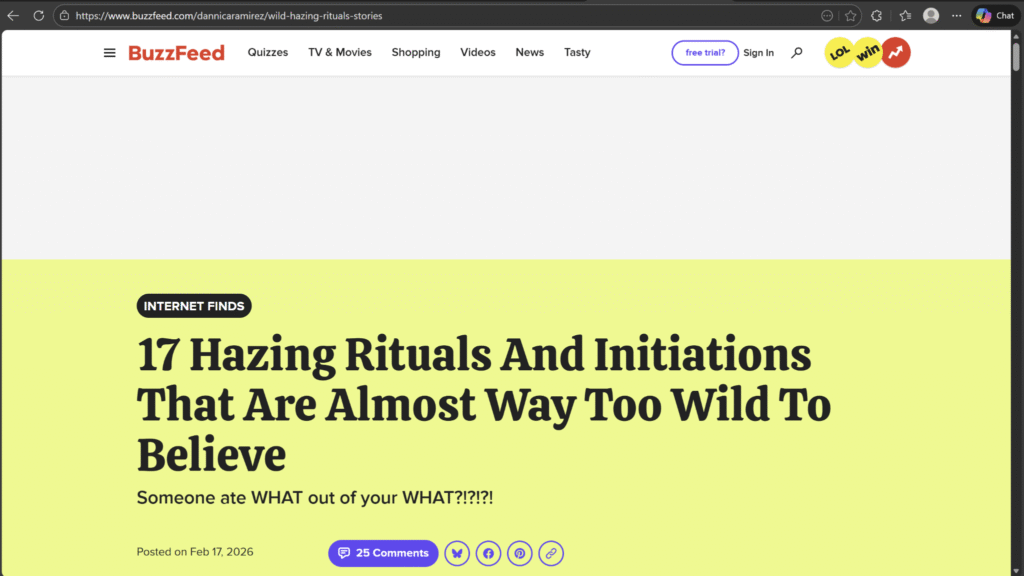
    “17 Hazing Rituals And Initiations That Are Almost Way Too Wild To Believe”

    Source: 17 Wildest Hazing Rituals People Have Been A Part Of

    I clicked on this headline because I was curious to know which “hazing rituals and initiations” were shocking to believe. Nowadays, I view these types of facts/news across multiple social media platforms, hence why I’m curious to know if these rituals and initiations have come across my feed before. Another reason why I clicked it was not because of the headline, but the subhead. The subhead is quite weird, “Someone ate WHAT out of your WHAT?!” which caught my attention and added to my current curiosity to find out what the author wrote regarding that statement in the article.

    I clicked on this headline because of the multiple uses of two-word and three-word phrases. The two-word phrase ”Hazing Rituals” immediately caught my attention as these are words that were easily scannable in a fraction of a second when I was skimming the headline, and it provided maximum impact, meaning they filled an information gap and made me understand that this article will be discussing about unusual rituals without having the need to reveal details. Adding to keyword phrases, In class we discussed superlatives and how they influence click-behavior. I noticed the use of a superlative in the second-half of the headline, “Are Almost Way Too Wild To Believe”. The word “Wild is not directly a superlative but instead a periphrastic superlative. This is because the author uses various words surrounding to build the highest of its kind. “Way Too” and “To Believe” are intensifier keywords that are added instead of using a singular word such as “Wild”, to increase the intensity of the content’s excellence and making readers think that they have reached that point of being unbelievable, promoting click-behavior.